Video of the work progress. Sorry for the crazy camera work, I am going to work on that.
Sunday, March 20, 2011
Handle Bars and Headlight
The tear down has officially started. I drained the engine oil and front brake fluid, took apart the speedometer assembly and removed 1/2 of the handle bar gear. Evan helped remove the front headlight with his new tools. He did a great job using his crescent wrench! So far, so good, nothing has been rusted on, nothing has broken, and no lost washers or snapped bolts. I bagged and tagged everything I thought was important; on the rebuild we will see if I did a good enough job!

Setup and Preperation
List of items and things I will need to help with organisation, tear down, and rebuild.
1. Boxes. I am going to start with diaper boxes, as I have a constant supply.
2. Digital camera. I am expecting this camera not to survive the project because I will not be able to wash my hands every time I take a photo.
3. Zip-lock baggies and a felt tip marker. To hold smaller pieces and nuts n' bolts.
4. Masking tap. For labeling parts.
5. Tools. Gotta sort out my metric from SAE. *sigh* that is always fun.
6. Clear garage space and set up tables. The wife is allowing me to lay siege to the garage. Thanks honey! =D
So here is a couple videos of the bike and works space.
So here is a couple videos of the bike and works space.
Saturday, March 19, 2011
The End Game Look
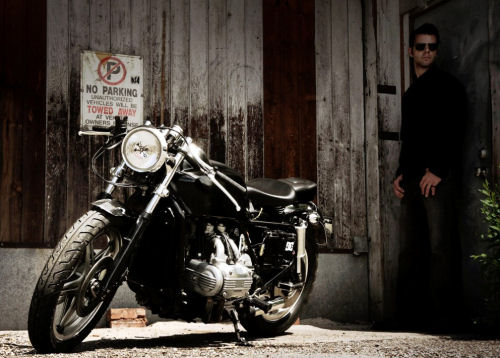

These photos are of GL1000s that have been restored and customized to their owner's taste. They are also my inspiration.
Friday, March 18, 2011
History of the GL1000
The Gold Wing made its debut at the Intermot motorcycle show in October 1974 as the GL1000. It featured a flat-four 999 cc (61.0 cu in) engine, and had a dry weight of 267 kg (590 lb). 13,000 units were sold in the United States in 1975.
Although the GL1000 was listed as a touring motorcycle, it was sold without fairings. Soon, a market developed offering fairings and luggage accessories, including the Windjammer series by Vetter Fairing Company. With only minor differences for different markets, the model remained virtually unchanged during the 1975 to 1977 production run. In 1978 many changes were introduced, including changes to the faux tank shape, instruments on the top of the faux tank, seat, camshafts, carburetors, exhaust system, Comstar wheels, and removal of the kickstart.
During the final run of the GL1000 in 1979, Honda included their own saddlebags and trunk, but still did not offer a fairing. Honda sold more than 97,000 units of the GL1000 in the United States between 1975 and 1979. Source
| Model: | Honda GL 1000 LTD Gold Wing |
| Year: | 1978 |
| Category: | Touring |
| Rating: | 73 out of 100. Show full rating and compare with other bikes |
| Engine and transmission | |
|---|---|
| Displacement: | 999.00 ccm (60.96 cubic inches) |
| Engine type: | Four cylinder boxer, four-stroke |
| Power: | 82.00 HP (59.9 kW)) @ 7500 RPM |
| Top speed: | 196.0 km/h (121.8 mph) |
| Compression: | 9.2:1 |
| Bore x stroke: | 72.0 x 61.4 mm (2.8 x 2.4 inches) |
| Valves per cylinder: | 2 |
| Fuel control: | OHC |
| Cooling system: | Air |
| Gearbox: | 5-speed |
| Transmission type, final drive: | Shaft drive (cardan) |
| Chassis, suspension, brakes and wheels | |
| Front tyre dimensions: | 3.50-19 |
| Rear tyre dimensions: | 4.50-17 |
| Front brakes: | Dual disc |
| Rear brakes: | Single disc |
| Physical measures and capacities | |
| Weight incl. oil, gas, etc: | 295.0 kg (650.4 pounds) |
| Fuel capacity: | 19.00 litres (5.02 gallons) |
Introduction
I am going to take a 34 year old Japanese motorcycle; tear it apart, repaint, refurbish, replace, and rebuild it. The journey will an incredible challenge, however, I will take each day one at a time and try to enjoy every minute of it. It is my hope that the end of this adventure will result in my bike fully operational and ready to ride. I am optimistically giving myself a 20% chance of success on this project, however, I am eagerly looking forward to the challenge and reward that might be waiting for me at the end.
This blog will serve three purposes:
1. To document my work.
2. To share my work with friends and family.
3. To serve as a therapeutic reflection that will allow me to examine what has been done, what needs to be done, and motivate me to continue.
My goals:
1. To have fun, learn about my bike, and each day, take a step forward to completing the project.
2. To restore my bike to a level of fidelity that would allow me to ride across the country.
3. To restore my bike without breaking the bank or consuming my life.
4. To do as much of the restoration as I can without outside help.
5. To blog the entire process!
It is my intention to photo document every step, piece, process, part, victory, and failure in this blog. As far as organisation goes, I doubt this blog will be updated daily, so I may make each "event" or "stage" of the build a separate blog entry. So stick around and check in when you like; at the very least you will get to see a 34 year old motorcycle in pieces!
Subscribe to:
Posts (Atom)